Consequences of the Armistice of 11 Nov 1918
A particularly famous event in modern Japanese history was the 27 October 1921 meeting in
Baden-Baden, Germany among three elite army Majors,
Nagata Tetsuzan,
 Military attaché in Switzerland at the time,
he went on to rise as a Lieutenant General to the powerful post
of Chief of the Military Affairs Bureau and ally with
Tōjō Hideki and Mutō Akira in the 'Control Faction',
inciting Lt. Col. Saburō Aizawa of the competing 'Imperial Way Faction'
to assassinate him in 1935 in revenge for his purges of that faction.
Military attaché in Switzerland at the time,
he went on to rise as a Lieutenant General to the powerful post
of Chief of the Military Affairs Bureau and ally with
Tōjō Hideki and Mutō Akira in the 'Control Faction',
inciting Lt. Col. Saburō Aizawa of the competing 'Imperial Way Faction'
to assassinate him in 1935 in revenge for his purges of that faction.
Japan NDL Page
Okamura Yasuji,
,
and
Obata Toshirō,
who as military attachés had been close observers of WWI and its aftermath.
One of the lessons they took from what they had seen was that future wars would like WWI be contests of total national power.
Another was surely that the allied democracies had accepted an end to the fighting with the front lines still out in France and Belgium, unwilling to make the sacrifices that would have allowed them to deliver to the German Army the definitive defeat of which they clearly were capable. Instead, they allowed Germany's troops to march home in good order, rifles on their shoulders, bands playing and flags flying, and agreed in the Versailles Treaty to allow Germany to retain a 100,000 man army, which the Germans proceeded to organize as an elite nucleus for future rearmament.
Should we be surprised that in August 1945, having a defensive position that enabled them to threaten Allied forces with far greater losses than the Germans could have threatened in November 1918, the hardliners in the Japanese leadership believed they could intimidate the Allies into a negotiated peace on similar terms?
General Pershing, commander of U.S. forces in Europe in WWI, stated his objections to the 1918 armistice in this letter.
These excerpts from a book by a British Major-General describe how the Allies could have continued on to definitively defeat the German Army at the end of WWI, and why they did not.
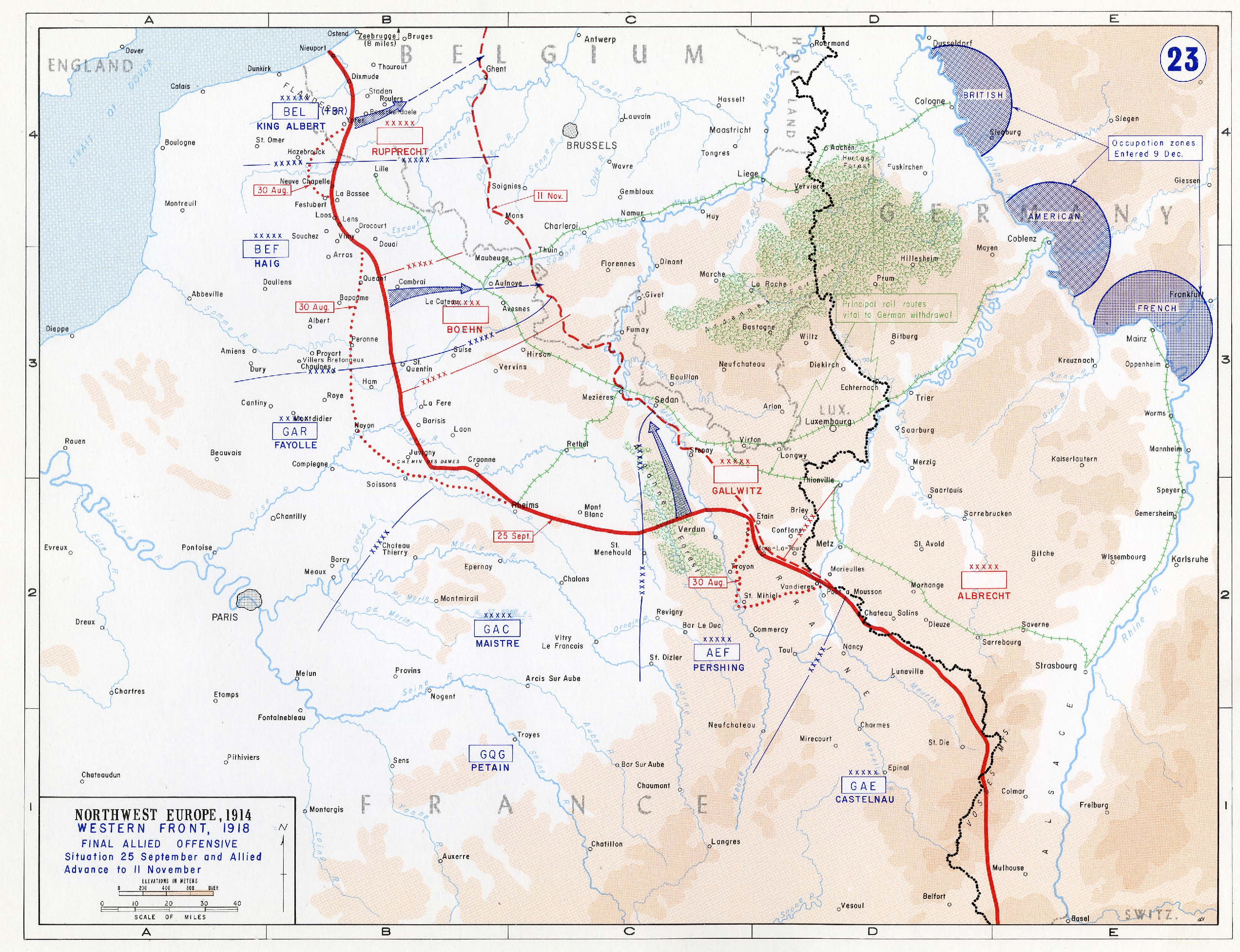
The map below shows the front at the time of the armistice in red dashes, and the German border in black dots. The blue semicircles are the areas occupied post-armistice on December 9 to safeguard bridgeheads over the Rhine while peace negotiations proceeded at Versailles. Note how far from Germany the front lines remained on the date of the armistice, and how little of Germany was occupied.
At the time of the armistice, Battery D of the 35th Division's 129th Field Artillery, Captain Harry S. Truman commanding, was positioned a little west of Moulainville, just behind the front lines, about 6 km east of Verdun near the center of this map it's last act having been to fire a barrage at Herméville-en-Woëvre. The Battery> had advanced to there during the battle from a point about 25 km to the west, Hill 290 near Neuvilly-en-Argonne, after deploying from near Saint Mihiel.